Характеристика І Оптимізація З Тирозиназа Інгібіторія Активність Of Vitis Amurensis Корінь Використання LC-Q-TOF-MS Coupled With A Біопроба І Відповідь Поверхня Методологія
Apr 26, 2023
Анотація%3а Vitis amurensis roots have been reported to have the potential for skin whitening through the evaluation of melanogenesis and tyrosinase inhibitory activities. In this study, V. amurensis roots were utilized to quickly select whitening ingredients using LC-Q-TOF-MS coupled with tyrosinase inhibitory assay, and to optimize the extraction process for use as a skin whitening functional material by response surface methodology. Results showed that V. amurensis roots exhibited tyrosinase inhibitory effects by two stilbene oligomers, ε-vinifera (1) and vitamin B (2), as predicted by LC-Q-TOF-MS coupled with bioassay. The optimal extraction conditions (methanol concentration 66 percent , solvent volume 140 mL, and extraction time 100 min) for skin whitening ingredients were established with yields of 6.20 percent , and tyrosinase inhibitory activity was 87.27 percent . The relationship between each factor and its corresponding response was confirmed by Pearson's correlation analysis. The solvent volume showed a clear linear relationship with yields, and methanol concentration had a strong linear relationship with tyrosinase inhibitory activity for compounds 1 and 2, as well as their combination. Overall, LC-Q-TOF-MS coupled with bioassay was proved to have the potential to effectively find new active constituents, as well as known active constituents; vitamins can be proposed as a new natural potential whitening agent.
Відповідний до релевантний дослідження,Cistanche is a common herb that is known as "the miracle herb that prolongs life". its main component is цистанозідАнтиоксидант, протизапальний,, and імунітет функція просування. Механізм між цистанче та шкіра відбілювання lies in the антиоксидант ефект of cistanche глікозиди. Меланін в людина шкіра є виробляється за окислення оф тирозин каталізується за тирозиназа, і the окислення реакція requires the участь of oxygen, so the безкисневі радикали in the body become an important factor affecting melanin production. Cistanche contains цистанозід, який Is an антиоксидант і Can Reduce The Generation of Free Radicals in the Body, Таким чином інгібування Меланіну Виробництво.
Натисніть Увімк. Цистанч Продано Ближнь Я
For more info:
david.deng@wecistanche.com WhatApp:86 13632399501
Ключові слова: Vitis amurensis; LC-Q-TOF-MS coupled with tyrosinase inhibitory assay; response surface methodology; Pearson's correlation
1. Вступ
Меланін є відповідальний за колір з ссавців шкіру і волосся і захищає шкіру від ультрафіолетові промені, але надлишок меланін продукція і накопичення оф меланіну в в шкіру причину гіперпігментацію шкіру розлади такі ас веснянки, мелазма, ефеліди, ефеліди, і старечий лентигіни. тирозиназа, відомі as a мідь-містить оксидаза фермент, has a вирішальна роль in меланін біосинтез. The фермент каталізується два послідовні окислення реакції: The first step, the hydroxylation of L-tyrosine to 3,4-dihydroxy-L-фенілаланін (L-DOPA), і секунда крок, the окислення of the L-DOPA to dopahinon. Dopaquinone is a highly reactive substance that can polymerize spontaneously to generate melanin [1–3]. Отже, тирозиназа інгібітори can be used as treatments for hyperpigmentation-related skin розлади і як відбілювання шкіри агенти.
Vitis amurensis, a wild-growing grape species, is mainly distributed in Asia (Korea, China, and Japan). Fully ripe fruits are consumed raw and contain abundant nutrients such as sucrose, glucose, protein, and vitamins, so they are used as a material for wine, juice, jellies, and jam. Additionally, its leaves are used in a salad [4]. Its roots and stems have been used as traditional medicine for the treatment of cancer, neuralgic pain, and abdominal pain [5,6]. Its roots consist of stilbenes (a main constituent), procyanidins, flflavonoids, triterpenoids, and other phenolic compounds. Until now, the chemical compositions of the root have been studied in sufficient detail. In particular, various stilbene oligomers, including resveratrol, amurensin A, vitamin A, ( plus )-ε-vinifera, amurensins C–M, ampelopsin A, D, and ampelopsin E, were reported [6]. The methanolic extract of the root exhibits an anti-melanogenic effect against -melanocyte stimulating hormone-induced melanogenesis in B16F10 cells and in 3,4-dihydroxyphenylalanine (L-DOPA) oxidation via mushroom tyrosinase [7]. Additionally, V. amurensis extracts and their active compounds exhibit antioxidant, anti-inflammatory, neuroprotective, and anti-tumorigenic effects [7–10].
LC-MS комбінований з a біопроба can одночасно підтверджує хімічний профіль і біологічна активність of components in natural products без the need for extraction and ізоляція. Тому, it has нещодавно been used to ефективно and fast identify bioactive compounds in natural products [11–13].
Optimization is a process that allows for the maximum efficiency of experimental systems or products. Response surface methodology (RSM), multivariate analysis, design of experiments using mathematical and statistical techniques based on empirical models, and expression of the correlation between experimental design and results as a polynomial function, are some techniques that provide ideal optimization conditions with maximum efficiency. RSM is an accurate and efficient optimization method widely used in various fields, including food processing, chemistry, biology, and agriculture [14–16]. Over the past decades, the interest in pharmaceuticals, cosmetics, and functional foods containing natural products has increased; consequently, there is ongoing research in both academia and industry aimed at developing such products [17,18]. The first step in these studies involves the extraction of the bioactive constituent from natural products. At this time, since numerous factors such as extraction time, temperature, liquid-solid ratio, and solvent volume affected the extracted constituents, an optimization for extracting the bioactive constituents to the maximum is required.
To our knowledge, tyrosinase inhibitory constituents and optimization of the extracts of V. amurensis roots have rarely been reported [5,19]. This study, much, aimed to fast obtain the tyrosinase inhibitor from V. amurensis roots using LC-Q-TOF-MS coupled with tyrosinase inhibitory assay and to optimize the extraction conditions for broadening the utilization of V. amurensis�% a0roots as a skin whitening agent by RSM.
2. Результати і Обговорення
2.1. LC-QTOF MS Coupled with a Tyrosinase Inhibitory Assay Using the Root Extract of V. amurensis
The 80 percent MeOH extract of V. amurensis root exhibitioned signifificant tyrosinase inhibitory activity (80.7 ± 0.8 percent at 50 µg/mL, Table S1). To identify the tyrosinase inhibitory compounds in V. amurensis root without isolation, LC-QTOF-MS coupled with a tyrosinase inhibitory assay was conducted. The chemical profile of the V. amurensis корінь екстракт was отриманий in the first run (Рисунок S1), і біоактивні сполуки були ідентифіковані використовують a тирозиназа інгібіторі аналіз оф фракції зібрані every 30 s from the second run (рисунок 1). Там були два піки між 19 і 22 min on the маса хроматограма прогнозована to have signifificant tyrosinase inhibitory activity, and їхня структура were identified to be stilbene dimer (1) and stilbene tetramer (2) using хімічний профілювання (таблиця 1).

2.2. Ідентифікація of Tyrosinase Інгібіторі Складові of V. amurensis Root
First, two constituents expected to have tyrosinase inhibitory activity were isolated from the EtOAc fraction, and their bioactivity was evaluated. The структури of the ізольовані сполуки 1 and 2 were identified as ε-vinifera (1) [20,21] and vitamin B ( -vinifera, 2) [21–23], відповідно, using 1H-NMR, 13C-NMR, and ESI-MS (Рисунок 2, Figures S2 and S3, і Table S2). In the tyrosinase inhibitory assay, the IC50 values of compounds 1, 2, and kojic acid were 3.51, 10.74, and 27.09 µM, відповідно. Обидва сполуки показані вищі тирозинази інгібіторі ефекти than the positive control, koJic кислота which is the known skin whitening constituent (Table 1 and Figure S4). In previous studies, ε-vinifera (1) is reported to have tyrosinase inhibitory activity [23]; однак, vitamin B (2) was first identified in our study.

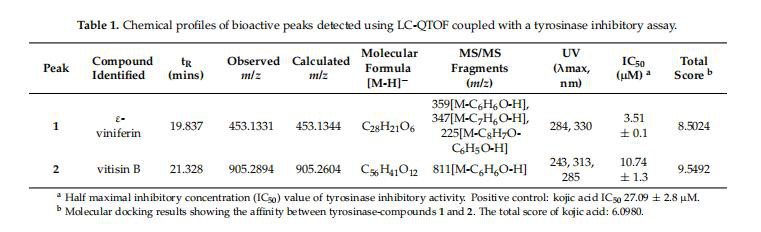

Overall, the results, correlated with the predicted data of LC-MS coupled with a tyrosinase inhibitory assay and vitamin B (2), show potential as a new tyrosinase inhibitor. Furthermore, molecular docking studies were conducted to support the result of the signifificant tyrosinase inhibitory activity of the two stilbene oligomers. As shown in Table 1, compounds 1 and 2 showed a higher docking score than the positive control, kojic acid, consistent with our experimental data. However, the docking results of compounds were contrary to our experimental results. The interaction modes of compounds 1 and 2 were described in Figure 3. Compound 1 formed 4 hydrogen bonds, 2 hydrophobic interactions, and 1 pi-lone pair interaction, and compound 2 formed 11 hydrogen bonds, 7 hydrophobic interactions, 1 van der Waals interaction, and 3 pi-lone pair interactions. As a result, it was confirmed that compounds can be inserted into the active site of the target protein and bind to catalytic amino acid residues that can inhibit tyrosinase activity. Additionally, ε-vinifera (1) is reported as a competitive inhibitor that binds to the same site that L-DOPA binds to tyrosinase [23]. It was observed that vitamin B (2) binds to the same site as ε-vinifera (1), which confirmed that vitamin B (2) is a new competitive inhibitor.

2.3. Оптимізація of V. amurensis Root Extraction Using RSM
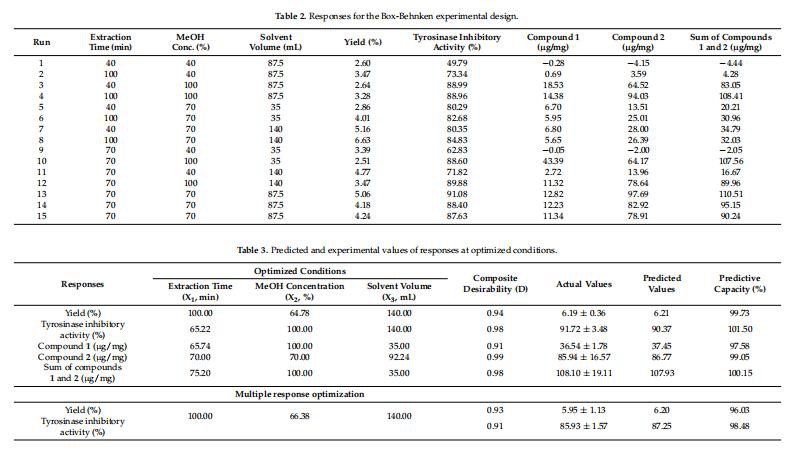
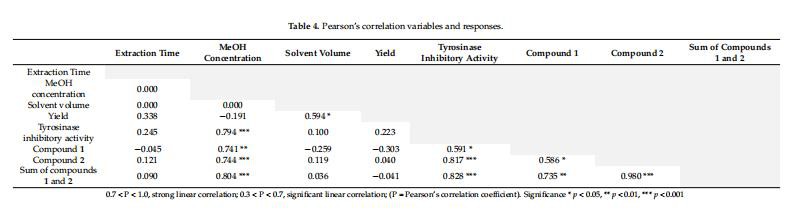
To utilize the V. amurensis roots as a skin-whitening functional material, the optimal extraction conditions were designed by Box-Behnken design (BBD) to maximize extraction yield and tyrosinase inhibitory activity. The effects of independent responses such as extraction yield, tyrosinase inhibitory activity, amount of compound 1, amount of compound 2, and amount of the sum of compounds 1 and 2, on the three independent variables (extraction time, MeOH/water concentration, and solvent volume), were measured (Table 2). The range of variables was set as extraction time (40, 70, and 100 min), MeOH concentration (40, 70, and 100 percent ), and solvent volume (35, 87.5, and 140 mL) based on a preliminary single-factor experiment (data not shown). The values obtained from the designed experiments were expressed as polynomials of correlations between variables using regression analysis (Tables S4–S13 and Figure S5). As a result of performing individual optimization for each reaction (Table 3), the yield was expected to represent 6.21 percent when extracted with 100.00 min, MeOH 64.78 percent , 140.00 mL. Tyrosinase inhibitory activity ( percent ) was extracted with 65.22 min, MeOH 100.00 percent , 140.00 mL conditions, and it was predicted to show a value of 90.37 percent . The amount of compound 1 at 65.74 min, MeOH 100.00 percent , 35.00 mL was predicted as 37.45 µg/mg, and the amount of compound 2 at 70.00 min, MeOH 70.00 percent , and 92.24 mL was predicted as 86.77 µg/mg. In addition, the total contents of compounds 1 and 2 were expected to show a maximum value of 108.10 µg/mg when extracted under conditions of 75.20 min, MeOH 100.00 percent , and 35.00 mL. Experiments based on optimized conditions yielded 6.19 ± 0.36 percent , tyrosinase inhibitory activity 91.72 ± 3.48 percent , compound 1 content 36.54 ± 1.78 µg/mg, compound 2 content 85.74 ± 16.57 µg/mg, and the sum of compounds 1 and 2 108.10 ± 19.11 µg/mg were obtained, and individual responses for each variable exhibited a difference of 5 percent or less from the theoretically predicted values. Multiple response optimization was performed to maximize extraction yield and tyrosinase inhibitory activity (Table 3). The optimized conditions were as follows: extraction time, 100 min; MeOH concentration, 66.38 percent ; and solvent volume, 140 mL. Using these conditions, the yield was determined to be 5.95 ± 1.13 percent and the tyrosinase inhibitory activity was 85.93 ± 1.57 percent ; these values were similar to the predicted values, 6.20 and 87.25 percent , respectively. Additionally, the correlation between each variable and the corresponding response was analyzed using Pearson's correlation (Table 4). The extraction yield showed a clear linear relationship between the extraction time and MeOH concentration and a negative linear relationship with the amount of compound 1. Additionally, the tyrosinase inhibitory activity showed a strong linear relationship between the amount of compound 2 and the amount of the sum of compounds 1 and 2 and a clear linear relationship with compound 1. Therefore, the tyrosinase inhibitory activity of V. amurensis root was proportional to both compounds 1 and 2 but exhibited a stronger linear relationship with the amount of compound 2 than compound 1.
3. Матеріали і Методи
3.1. General Experimental Procedures
Середній тиск рідина хроматографія (MPLC) was conducted using a Biotage Isolera (Biotage AB, Uppsala, Швеція). One system is оснащений with a high-performance flash хроматографія (HPFC) pump, a variable dual-wavelength detector, and a collector. NMR spectra were acquired using a Bruker SPECTROSPIN 300 MHz spectrometer (Bruker Corporation, Billerica, MA, USA). Methanol-d4, an NMR solvent, was purchase from% c2�Cambridge Isotope Laboratories, Inc. Acetonitrile (ACN), water, and methanol (MeOH) of chromatographic grade were purchased from ThermoFisher Scientific Korea Ltd. (Seoul, Republic of Korea). L-tyrosine, mushroom tyrosinase, kojic acid, and formic acid were purchased from Sigma–Aldrich Co (St. Louis, MO, USA).
3.2. Рослина Матеріал
V. amurensis root was obtained from Gyeongbuk, Korea, and also purchased from Omniherb (Daegu, Republic of Korea). They were identified by Dr. Prof. Ki Yong Lee, from the College of Pharmacy at Korea University. A voucher specimen (KUP-HD071) was deposited at the Laboratory of Pharmacognosy, College of Pharmacy, Korea University.
3.3. LC-Q-TOF Маса Спектрометрія
LC was performed using an Agilent 1260 series (Agilent, Santa Clara, CA, USA) comprising a binary pump, online degasser, autosampler, thermostatically controlled column compartment, and photodiode array detector. Chromatographic separation was performed using a Shiseido CapCell PAK C18 column (5 µm, 4.6 mm, I.D × 150 nm). The mobile phase consisted of water (solvent A) and ACN (solvent B), both containing 0.1 percent formic acid. The gradient conditions were as follows: 0–5 min, 10 percent B, 5–30 min, and linearly increase B from 10 to 90 percent . The fellow rate was set to 0.6 mL/min; 5 µL and 20 µL of the samples were injected for LC-Q-TOF-MS analysis and LC-Q-TOF-MS coupled with tyrosinase inhibitory assay, respectively. Mass spectrometry was performed using an Agilent 6530 Q-TOF mass spectrometer (Agilent, Santa Clara, CA, USA) with an electrospray ionization (ESI) interface in negative mode. Data of mass range from m/z 50–1000 was collected in centroid mode. The mass parameters were as follows: capillary voltage, 4000 V; nebulizer pressure, 40 psi; fragment voltage, 175 V; skimmer voltage, 65 V; drying gas temperature, 325 ◦C; fellow rate of drying gas, 12.0 L/min; collision energy 10, 20, 30, and 40 eV. Acquisition parameter adjustment and data processing were performed using LC-MS/MS Data Acquisition by using 6530 series Q-TOF (version B.05.00) (MassHunter Workstation software, Agilent, Santa Clara, CA, USA).
3.4. LC-Q-TOF-MS Coupled with a Tyrosinase Інгібіторій Аналіз
LC-Q-TOF-MS coupled with a tyrosinase inhibitory assay was conducted using the method established in the previous study [24]. In brief, the assay proceeded in two runs. In the first run, the chemical profile of the sample was obtained using LC-Q-TOF-MS. In the next run, the eluate after passing through the LC system under the stated LC-Q-TOF conditions was collected in 96-well plates every 30 s. The tyrosinase inhibitory activity of the collected fractions was evaluated using a tyrosinase inhibitory assay.

3.5. Isolation of Tyrosinase Inhibitory Compounds from V. amurensis Root
For the isolation of tyrosinase inhibitory compounds identified using LC-Q-TOF-MS coupled with the tyrosinase inhibitory assay, V. amurensis root (3.01 kg) was extracted three times with 80 percent MeOH for 60 min at room temperature using ultrasonication. The extracted solvent was filtered and concentrated to obtain a crude extract (215.7 g), which was suspended in water and sequentially partitioned using n-hexane, ethyl acetate (EtOAc), and n-BuOH. The EtOAc fraction (25.85 g) was subjected to silica gel column chromatography using n-hexane: EtOAc under gradient conditions (20:1 → 0:1) to yield seven fractions (E1–E7). Fraction E4 was separated using MPLC and 100 g SNAP KP-Sil, a silica gel cartridge, and dichloromethane: MeOH under gradient conditions (97:3 → 0:100) to yield seven sub-fractions (E4–1 to E4–7). Compound 2 (417.0 mg) was obtained from E4–5. Sub-fraction E4–4 was re-chromatographed on MPLC using SNAP 25 g Ultra, a silica gel cartridge, and chloroform:MeOH: H2O under gradient conditions (50:4:1 → 15:4:1) to yield seven fractions (E4–4–1 to E4–4–7). Compound 1 (396.0 mg) was obtained from E4–4–5, which was observed as a single spot on a thin layer chromatography (TLC) plate.
3.6. Тирозиназа Інгібітор Аналіз
The tyrosinase inhibitory activity was evaluated using a previously described method with slight modification [25]. The two microliters of sample and 50 µL of 0.1 U/µL mushroom tyrosinase were treated in 96-well plates and incubated at 37 ◦C. After 15 min, 50 µL of 1 mM L-tyrosine was added and then reacted at 37 ◦C for 15 min. The amount of dopachrome formed was measured at 495 nm using a Spectra Max 19{{20}} microplate reader (Molecular Devices, San Jose, CA, USA). Tyrosinase inhibitory activity was calculated using the following equation: tyrosinase inhibition ( percent )=[1 − (S − S0)/(C − C0)] × 100, where S is the absorbance of sample, tyrosinase, and L-tyrosine; S0 is the absorbance of the sample and L-tyrosine; C is the absorbance of tyrosinase and L-tyrosine, and C0 is the absorbance of L-tyrosine. Kojic acid, a known tyrosinase inhibitor, was used as a positive control. IC50 values were calculated using GraphPad Prism 6 (GraphPad Software, Inc., La Jolla, CA, USA).
3.7. Molecular Docking Studies
Молекулярний стикування бус виконаний by using SYBYL-X 2.1.1 software (Tripos Ltd., St. Louis, MO, USA) with crystal structures of PPO3, a tyrosinase from Agaricus bisporus (Protein Data Bank (PDB) ID: 2Y9W). All the water molecules of the target protein were removed, and ligand preparation was conducted by "sanitize" preparation protocol in SYBYL-X 2.1.1. Protein-ligand affinity was calculated by the Tripos force field and expressed as total scores. The doccked pose of the ligand from the protein-ligand complex was visualized in Discovery Studio 2017 R2 Client program (Biovia Co., San Diego, CA, USA).
3.8. Експериментальний Проект і Статистичний Аналіз
An optimized condition for extracting constituents with maximum tyrosinase inhibitory activity from V. amurensis root was established using the BBD with three variables and three levels (MINITAB Release 14.12.0 Statistical Software). Based on the preliminary single-factor experiment results, the independent variables including extraction time (X1), MeOH and water concentration (X2), and liquid volume (X3), and a range of their variables were selected (Table S3). The variables for RSM were coded using three levels, −1, 0, and 1. Overall, 15 experiments were designed including 3 replicates at the center of the design (Table 2). As independent responses, yield ( percent ), tyrosinase inhibitory activity ( percent ), the amount of compound (1) (µg/mg), and the amount of compound (2) (µg/mg), were measured. Tyrosinase inhibitory activity of the extract was evaluated at a concentration of 50 µg/mL. Each response is expressed using the following second-order polynomial equation:

де R denotes the response; 1, 2, and 3 are the linear coefficients; 12, 23, and 13 are the interaction coefficients between three variables; and 11, 22, and 33 are the quadratic coefficients.
Furthermore, Pearson's correlation analysis was performed to determine the existence of a linear relationship between each variable and response. Pearson's correlation coefficient has a strong linear relationship between {{0}}.7 and 1.0, a clear linear relationship between 0.3 and 0.7, a weak linear relationship between {{10}}.1 and 0.3, and no or negligible linear relationship between 0.0 and 0.1. The positive and negative correlation is expressed depending on whether Pearson's correlation coefficient is positive or negative.
3.9. Кількісний Аналіз з Інгібіторний тирозиназа Сполуки 1 і 2
The amount of each compound 1 and 2 in extracts obtained using the designed 15 experimental conditions were measured using the calibration curves (Table 2). The calibration curves for compounds 1 and 2 were determined using the area under the UV chromatogram curve (330 nm acquired at concentrations of 0.1–1000 µg/mL and 7.81–1000 µg/mL, respectively). LC was performed using a Waters 2695 LC system (Waters, Santa Clara, CA, USA) with the same conditions as those of the LC system detailed in Materials and Methods, LC-Q-TOF mass spectrometry.
4. Висновки
ε-вініферин (1) і вітамін B (2) of V. amurensis roots were characterized as skin-whitening constituents using LC-Q-TOF-MS coupled with a tyrosinase інгібіторій аналіз. In particular, вітамін B (2) was first identified as a tyrosinase inhibitory compound in this study and ε-vinifera (1) and vitamin B (2) showed higher tyrosinase inhibitory effects than the positive control, kojic acid. the optimization conditions with with максимум тирозиназа інгібіторі ефект і врожайність of V. амуренсис корені були встановлено використовують екстракція час (100 хв), MeOH концентрація (66.38 відсоток ), і рідина об'єм (140 мл). The result exhibitioned a good correspondence between experimental and predicted values. Отже, LC-Q-TOF-MS coupled with bioassay has proved the potential to effectively find new active constituents, as well as known active constituents, vitamin B (2), which can be proposed as a new natural potential whitening agent.

Доповнення Матеріали: The following are available online, Figure S1: MS chromatogram in negative ionization mode (A); UV chromatogram at 280 nm (B) of extracts of V. amurensis roots, Figure S2: 1H-and 13C-NMR spectra of compound 1 (300 and 75 MHz, CD3OD), Figure S3: 1H-and 13C-NMR spectra of compound 2 (300 and 75 MHz, CD3OD), Figure S4: Sigmoidal plot and IC50 of positive control, compounds 1 and 2, Figure S5: Response surface and contour plots showing the effect of extraction parameters (X1: extraction time, min; X2: MeOH concentration, percent ; X3: solvent volume, mL). (A) yield; (B) tyrosinase inhibitory activity; (C) compound 1; (D) compound 2; (E) sum of compounds 1 and 2, Table S1. Tyrosinase inhibitory activity of extracts of V. amurensis roots, Table S2: 1H- and 13C NMR data of compounds 1 and 2 in CD3OD (δ in ppm), Table S3: Independent variables and levels for response surface methodology, Table S4: Estimated regression coefficient for yield, Table S5: Analysis of variance for yield, Table S6: Estimated regression coefficient for tyrosinase inhibitory activity, Table S7: Analysis of variance for tyrosinase inhibitory activity, Table S8: Estimated regression coefficient for compound 1, Table S9: Analysis of variance for compound 1, Table S10: Estimated regression coefficient for compound 2, Table S11. Analysis of variance for compound 2, Table S12: Estimated regression coefficient for the sum of compounds 1 and 2, Table S13: Analysis of variance for the sum of compounds 1 and 2.
Автор Внески: Концептуалізація, K.; Y.L.; METHODOLOGY, K.-E.O., H.S., and K.Y.L.; software, K.-E.O., and H.S.; validation, H.S.; formal analysis, K.-E.O., and H.S.; investigation, K.-E.O., H.S., M.K.L., and K.Y.L.; data curation, K.-E.O., H.S., B.P., and K.Y.L.; writing�% 94 оригінал чернетка підготовка, K.-E.O., and H.S.; writing—review and editing, H.S., M.K.L., B.P. and K.Y.L.; supervision, M.K.L., B.P., and K.Y.L. All authors have read and agreed to the published version of the the manuscript.
Це дослідження було підтримано те національне дослідження Фонд оф Корея грант фінансоване by те корейське уряд (NRF-2017R1A2B4003403 and NRF-2019R1A6A1A03031807) and a grant of the Korea Health Technology R&D Project through the Korea Health Industry Development Institute (KHIDI), funded by the Ministry of Health and Welfare, Republic of Korea (HF20C0038).
Дані Доступність Виписка: The data presented in this study are available in the supplementary material.
Конфлікти інтереси: The authors declare no conflict of interest.
Зразок Наявність: Not available
1. Ranjbar, S.; Shahvaran, P.S.; Edraki, N.; Khoshneviszadeh, M.; Darroudi, M.; Sarrafifi, Y.; Hamzehloueian, M.; Khoshneviszadeh, M. 1, 2, 3-Triazole-linked 5-benzylidene (thio) barbiturates as novel tyrosinase inhibitors and free-radical scavengers. Arch. Pharm. 2020, 353, 2000058. [CrossRef] [PubMed]
2. Chang, T.-S.; Ding, H.-Y.; Lin, H.-C. Identifying 6, 7, 40 -trihydroxyisoflflavone as a potent tyrosinase inhibitor. Biosci. Biotechnol. Biochem. 2005, 69, 1999–2001. [CrossRef] [PubMed]
3. Miyazawa, M.; Oshima, T.; Koshio, K.; Itsuzaki, Y.; Anzai, J. Tyrosinase inhibitor from black rice bran. J. Agric. Food Chem. 2003, 51, 6953–6956. [CrossRef]
4. Chen, Q.; Diao, L.; Song, H.; Zhu, X. Vitis amurensis Rupr: A review of chemistry and pharmacology. Phytomedicine 2018, 49, 111–122. [CrossRef] [PubMed]
5. Jin, K.-S.; Oh, Y.N.; Hyun, S.K.; Kwon, H.J.; Kim, B.W. Betulinic acid isolated from Vitis amurensis root inhibits 3-isobutyl-1- methylxanthine induced melanogenesis via the regulation of MEK/ERK and PI3K/Akt pathways in B16F10 cells. Food Chem. Toxicol. 2014, 68, 38–43. [CrossRef]
6. Kim, H.; Thuong, P.T.; Ngoc, T.M.; Lee, I.; Hung, N.D.; Bae, K. Antioxidant and lipoxygenase inhibitory activity of oligostilbenes from the leaf and stem of Vitis amurensis. J. Ethnopharmacol. 2009, 125, 304–309. [CrossRef]
7. Jin, K.-S.; Oh, Y.N.; Hyun, S.K.; Kwon, H.J.; Kim, B.W. Vitis amurensis Ruprecht root inhibited -melanocyte stimulating гормон-індукований melanogenesis in B16F10 cells. Nutr. Res. Pract. 2014, 8, 509–515. [CrossRef]
8. Jang, M.H.; Piao, X.L.; Kim, H.Y.; Cho, E.J.; Baek, S.H.; Kwon, S.W.; Park, J.H. Ресвератрол олігомери від Vitis amurensis attenuate -амілоїд-індукований окислювальний стрес in PC12 cells. Biol. Pharm. Bull. 2007, 30, 1130–1134. [CrossRef]
9. Lee, E.-O.; Lee, H.-J.; Hwang, H.-S.; Ahn, K.-S.; Chae, C.; Kang, K.-S.; Lu, J.; Kim, S.-H. Potent inhibition of Lewis lung cancer growth by hexanol A from the roots of Vitis amurensis through apoptotic and anti-angiogenic activities. Carcinogen 2006, 27, 2059–2069. [CrossRef]
10. Bak, M.-J.; Truong, V.L.; Kang, H.-S.; Jun, M.; Jeong, W.-S. Протизапальний ефект of procyanidins from wild grape (Vitis amurensis) seeds in LPS-induced RAW 264.7 cells. Oxid. Med. Cell. Longev. 2013, 2013. [CrossRef]
11. Shin, H.; Chung, H.; Park, B.; Lee, K.Y. Ідентифікація of антиоксидантні складові від Polygonum aviculare using LC-MS coupled with DPPH assay. Nat. Prod. Sci. 2016, 22, 64–69. [CrossRef]
12. Park, S.; Shin, H.; Park, Y.; Choi, I.; Park, B.; Lee, K.Y. Characterization of inhibitory constituents of NO production from Catalpa ovata using LC-MS coupled with a cell-based assay. Bioorg. Chem. 2018, 80, 57–63. [CrossRef] [PubMed]
13. Ingkaninan, K.; De Best, C.; Van Der Heijden, R.; Hofte, A.; Karabatak, B.; Irth, H.; Tjaden, U.; Van der Greef, J.; Verpoorte, R. High-performance liquid chromatography with on-line coupled UV, mass spectrometric and biochemical detection for identification of acetylcholinesterase inhibitors from natural products. J. Chromatogr. 2000, 872, 61–73. [CrossRef% 5д
14. Bezerra, M.A.; Santelli, R.E.; Oliveira, E.P.; Villar, L.S.; Escaleira, L.A. Response surface methodology (RSM) as a tool for optimization in analytical chemistry. Talanta 2008, 76, 965–977. [CrossRef] [PubMed]
15. Witek-Krowiak, A.; Chojnacka, K.; Podstawczyk, D.; Dawiec, A.; Pokomeda, K. Application of response surface methodology and artificial neural network methods in modeling and optimization of biosorption process. Bioresour. Technol. 2014, 160, 150–160. [CrossRef] [PubMed]
16. Araujo, P.W.; Brereton, R.G. Experimental design I. Screening. Trends Analyst. Chem. 1996, 15, 26–31. [CrossRef]
17. Wang, Y.; Zhao, L.; Zhang, R.; Yang, X.; Sun, Y.; Shi, L.; Xue, P. Optimization of ultrasound-assisted extraction by response surface methodology, антиоксидант ємність, and tyrosinase інгібіторі активність of anthocyanins from red rice bran. Food Sci. Nutr. 2020, 8, 921–932. [CrossRef]
18. Weremfo, A.; Adulley, F.; Adarkwah-Yiadom, M. Simultaneous Optimization of Microwave-Assisted Extraction of Phenolic Compounds and Antioxidant Activity of Avocado (Persea americana Mill.) Seeds Using Response Surface Methodology. J. Anal. Methods Chem. 2020, 2020, 7541927. [CrossRef]
19. Ko, J.; Choi, J.; Bae, S.K.; Kim, J.; Yoon, K.D. Separation of five oligostilbenes from V it is amurensis by fellow-rate gradient high-performance countercurrent chromatography. J. Sep. Sci. 2013, 36, 3860–3865. [CrossRef]
20. Wang, K.-T.; Chen, L.-G.; Tseng, S.-H.; Huang, J.-S.; Hsieh, M.-S.; Wang, C.-C. Anti-inflammatory effects of resveratrol and oligostilbenes from Vitis thunbergii var. taiwaniana against lipopolysaccharide-induced arthritis. J. Agric. Food Chem. 2011, 59, 3649–3656. [CrossRef]
21. Hu, J.; Lin, T.; Xu, J.; Ding, R.; Wang, G.; Shen, R.; Zhang, Y.-W.; Chen, H. Polyphenols isolated from leaves of Vitis thunbergii var. taiwaniana regulate APP related pathway. Bioorg. Med. Chem. Lett. 2016, 26, 505–511. [CrossRef] [PubMed]
22. Oshima, Y.; Kamijou, A.; Ohizumi, Y.; Niwa, M.; Ito, J.; Hisamichi, K.; Takeshita, M. Novel oligostilbenes from Vitis coignetiae. Tetrahedron 1995, 51, 11979–11986. [CrossRef]
23. Anna Malinowska, M.; Billet, K.; Drouet, S.; Munsch, T.; Unlubayir, M.; Tungmunnithum, D.; Giglioli-Guivarc'h, N.; Hano, C.; Lanoue, A. Grape Cane Extracts as Multifunctional Rejuvenating Cosmetic Ingredient: Evaluation of Sirtuin Activity, Tyrosinase Inhibition, and Bioavailability Potential. Molecules 2020, 25, 2203. [CrossRef] [PubMed]
24. Yang, H.H.; Oh, K.-E.; Jo, Y.H.; Ahn, J.H.; Liu, Q.; Turk, A.; Jang, J.Y.; Hwang, B.Y.; Lee, K.Y.; Lee, M.K. Characterization of tyrosinase inhibitory constituents from the aerial parts of Humulus japonicus using LC-MS/MS coupled online assay. Bioorg. Med. Chem. 2018, 26, 509�% 93515. [CrossRef] [PubMed]
25. Liu, Q.; Kim, C.; Jo, Y.H.; Kim, S.B.; Hwang, B.Y.; Lee, M.K. Synthesis and biological evaluation of resveratrol derivatives as melanogenesis inhibitors. Molecules 2015, 20, 16933–16945. [CrossRef] [PubMed]
For more info: david.deng@wecistanche.com WhatApp:86 13632399501